Tuesday, January 29, 2013

Frock Coat 2: The Guts

 When I last left you, I had finished the collar of the frock coat. I won't come back to the collar for a long time, so I really did it out of order, but that's all right. The next thing I did was baste the finished canvas to the coat fronts, and pad stitch the revers (also known as the lapel).
Here you can see (and you can click for larger images)  the pad stitching which lends the revers its shape. I haven't ironed it, but it maintains a fairly sharp crease, and also curls back toward the point of the revers. Underneath you can see the dart that gives the chest some shape, and a few dimples where the pad stitching is.

Underneath the armscye I've added a little padding. This is batting covered by thin linen which I've pad stitched to the fabric. This will fill out the little hollow under the arm.

 A final picture of the completed interior of the front of the coat.

Now I've attached the back and skirts, and added a strip of linen at the bottom hem to help keep the coat draping properly.

In addition to the linen strip, I've also added a few lead weights. This is a very soft linen coat fabric, and the weights will help it hang properly.

I've begun turning in the fronts in anticipation of adding the facings. You can see here an additional piece of linen added to help support the buttons along the front edge.

Now to add some pockets. There are no side or front pockets on this coat, to maintain the proper form, but instead it has two pockets hidden in the tails. I've cut the lining for the tails in two pieces, and made pocket shapes.

In retrospect, I should have cut the pockets to be shaped within the red dotted lines - this would have helped them hang straight, since they would have been supported by the waist seam.

The finished pocket. It may be hard to see, but I've added reinforcement at the corners of the pocket opening so it doesn't rip open.

A closer look at the pocket.

Completed skirt lining. On this side the pocket is at the top left of the lining, by the top of the back vent opening.

Thursday, January 10, 2013

Frock Coat 1: Drafting and Canvas

Sorry I haven't posted very much recently. I haven't been idle, but I was working on a few Christmas gifts (including a kilt for my two year-old nephew) that didn't pertain to this blog.
Anyway, next on the lineup is a frock coat. Once again, I drafted my own pattern, based this time on a combination of drafts from R.I. Davis' Men's Garments, 1830-1900.The collar is my own design, so we'll see how it works out. I just haven't been able to successfully draft a collar based on any system I've seen yet, but the second version I made for my muslin version of the coat seemed to work out well.
The first step for the frock coat (now basically following Maclochlainn's hasty jacket directions at the end of his book) is to prepare the canvas. This is especially important for me, since I'm not making my frock coat from heavy wool, but from a very nice herringbone linen I found. It is very soft and drapey, and I need to make sure that it's well-supported. There are a series of diagrams and pictures in both Davies and Maclochlainn that describe the setup of coat canvasing, but I mainly used this diagram from Davies:


As you can see, there are three pieces - the main canvas, and then two additional pieces which reinforce the shoulder and chest. I cut the main pieces and one of the additional pieces on the straight grain, and the second shoulder canvas on the bias. Here are the main pieces and the collar canvas pieces.


I could just go from there, but the next step is to shape the canvas so that it is more three-dimensional, and not just a flat piece. In order to do that, I took the dart out of the neck gore/lapel that you can see drawn in above, and then opened up several V's (what's the opposite of a dart? That's what these are) as you can see below, and inserted fabric to keep them open. As you can see, the lines start to flow and the canvas no longer lies flat on the table.


Now, after I've added the two shoulder/chest pieces (which have similar V's inserted into them) I pad stitched them all together. The vertical white lines are chalk lines to keep it all neat, and the chevrons are the pad stitching.


Next, I laid out my pattern pieces on the fabric. You can't see it in this photo, but the next couple will show off the true pattern and colour of the linen.


I've seen many different methods of pad stitching or otherwise attaching the canvas to the undercollar. I went with Maclochlainn on this one, which has you pad stitch the collar part, and side stitch the stand. You can't really see the side stitching in this photo because the stitches are small, but it does add body to the stand. Here I haven't ironed the fall line yet - just pressed it with my fingers - but it gives a good idea of how the collar will fall.


This was a lucky break - I didn't even plan it because I completely forgot to think about it, but the herringbones lined up perfectly where the undercollar seam is, to form a chevron. Actually, now that I look at it again you can see that the grains are reversed. Ah well, you'll never see this part of the collar anyway. Even though you can't see any of the thread from the pad stitching.


Monday, December 24, 2012

Smoking Cap

It's cold outside, and it's snowing. A perfect time for a smoking cap.

This cap has two uses. The first - and whence the name - is it is what men would wear when they would smoke their cigars or pipes, in order to keep their hair from smelling smokey. This is also the idea behind the smoking jacket - something to keep your clothes smelling fresh. However, since I have (and many men of the time had) a moustache, there really isn't a lot you can do to keep from smelling smoky. Once you've smoked, if you try to kiss your sweetie she'll know. ;)

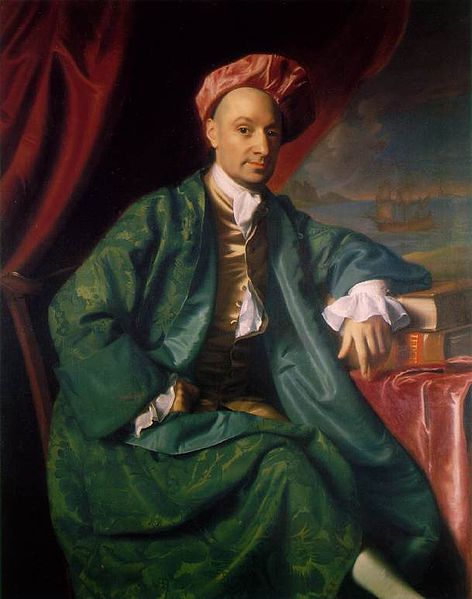
The other reason, and I think where the hat probably came from originally, is simply that without central heating it was cold in most houses, and you needed something to wear on your head. Not too formal - save the top hats and bowlers and homburgs for out-of-doors - but to wear in your own home you'd have a smoking cap, and a smoking jacket to wear along with it. These are really holdovers from an earlier time when men would wear a banyan:

Ward Nicholas Boylston in a brilliant green banyan and a cap, painted by John Singleton Copley, 1767. From Wikipedia.
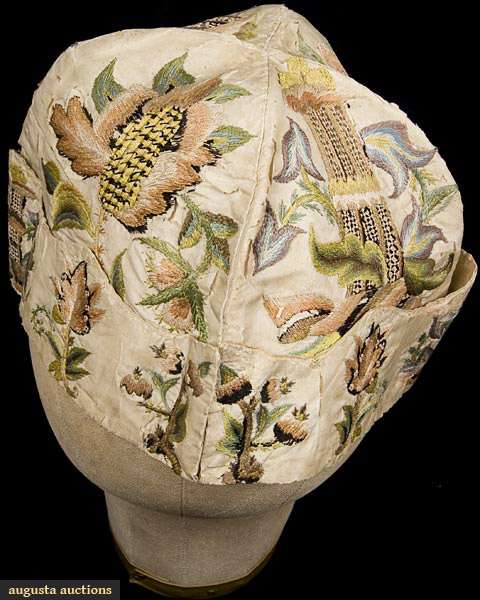
Well, I'll tackle the smoking jacket in another post. But as you can see, this picture shows Boylston also wear a turban-like hat. In the 18th century this hat was generally made of four panels of fabric coming together in a peak:

From: Modemakt/Power of Fashion Blog
From: Augusta Auctions

These would eventually change to more of a fez/pillbox shape for the Victorian smoking cap.

There are plenty of links online to patterns for smoking caps from Godey's Magazine (sort of a Victorian version of Better Homes & Garden and Vogue, mashed together), but most of them are appliqué or couched cord and braid. I wanted to embroider my pattern, so I found (what I thought was) a simple motif, and repeated it three times on a piece of paper the diameter of my head. I figured that three inches tall looked about right.


I then used that paper as a pattern to cut out a length of heavy wool broadcloth - this is probably 28oz melton, definitely coat-weight - and a strip of linen backing. In the end I really didn't need the linen, but it helps the inside look neat. I cross stitched the wool to the linen.


I then basted the paper with the motifs onto the wool, and back-stitched around all of the borders. If I did this again I'd use stem stitch instead, for a fuller, more raised border, but at least that transferred the pattern to the cloth. I then tore away the paper, picked out the little bits from underneath the stitches with a pair of tweezers, and was ready to embroider.


Almost all of the embriodery is padded satin stitch. Some of the leaves are herringbone stitch, and the purple tips of the white flower are French knots. This wasn't simple. All told, it took at least 40 hours to embroider all three motifs.


As you can see from the back, I tried to keep the amount of embroidery floss used to a minimum.


And the finished cap. The button is a metal washer covered with the same wool.


Now, having shown all that, let me just say that making a smoking cap is not tailor's work. You might have been able to purchase one pre-made in a haberdashery, but most often I believe they were made by a wife for her husband. There's a reason so many patterns show up in Godey's ladies magazine. However, from the amount of work it takes to embroider such a cap, it's no wonder that most of the patterns are for couching and appliqué - those methods are much faster!

Sunday, November 18, 2012

Waistcoat 6: Finished

Finished! I like this waistcoat quite a bit. It fits very nicely, high under the arm in the armscye, which will give me good ease of movement. I know I haven't shown myself wearing any of the things I've finished recently, but once I have a whole outfit put together I'll wear everything at once.

This is the first time I've used silk thread for buttonholes. I have to say it's quite nice to work with. The only problem with these buttonholes is that the linen unraveled so easily. I had to do some thick overcast serging with regular thread before moving to the silk twist. 

Monday, November 5, 2012

Waistcoat 5: Almost Finished

First of all, here's a picture of what I was talking about in the last post, where the collar is sewn into the shoulder seam. This reduces additional bulk in the back, and keeps the collar from pressing against the back of your neck from the weight of the coat. A little thing, but remember that in Victorian times the coat was never taken off, so it doesn't matter what the back of your waistcoat looked like.


Now some pictures of the waistcoat at this stage. All it needs are buttonholes and buttons. And maybe a back adjustment strap. I was trying to make it fit well enough to not need a strap and buckle, but I think it will work better with it.

Here you can see some chalk marks I drew to make sure I line everything up correctly when putting on the buttons.

The back. I really wanted to make this of the same material as the lining, but as I bought the end of a roll of fabric for the lining I didn't quite have enough. I tried to make it work, even with the stripes running horizontally, but it just wasn't going to happen.

The lining. You can see pleats at the front shoulders in the lining to help keep it from pulling.

Detail of the felling where the lining meets the front facings.

And a detail of where the back lining meets the front. Remember that the front pieces were already lined before I added the back, so the back lining is felled onto the front lining.

I could have just made simple buttons, but I figured that a little extra something was worth it. I decided to do a very simple embroidery - just a few crossed lines tied together where they all cross. I did a circle of stay stitching around the edge of the button because this fabric frays very easily. Without the stitching, the fabric would just all fall apart at the back where I stitched it over the button molds.

A completed button. I sewed a thread shank onto the back of this one, but I'm not sure if I want to keep that, or simply sew the buttons directly onto the waistcoat. We'll see how this one works, or if it stands too far off the fabric.


Thursday, November 1, 2012

Waistcoat 4: Collar


This little guy was giving me some problems.

I was initially going to have a full collar on this waistcoat, with a stand and collar, wrapping all the way around the neck. My first draft of it was much too long, as I discovered in my muslin, so then I was waiting until I had completed the waistcoat before drafting the collar.

Since then I learned two things: first of all, how to draft the collar as it would look folded down, on the pattern draft, instead of opened up. That would have been easier than the way I did it, which is just to guess how the revers/lapel would fold down and look, and would have made it easier to judge the notch in the lapel. It would also have allowed me to draft the entire collar as part of the facing which wraps from the inside of the vest to the collar facing. Does that make sense? No? I'll have to find some pictures for a later post.

The second thing I learned is that many waistcoats, unless they have a shawl collar, just ended the collar at the shoulder seam. That is what I will do, so this little bit here is the underside of the collar, with the canvas pad stitched to give it some stiffness, and to create the roll from the stand to the collar. The front (right) will attach to the top of the lapel, and the rear (left) will be seamed into the shoulder seam. The next post will make all of this make sense, I promise.

Wednesday, October 24, 2012

Waistcoat 3: Canvas

 First of all, let me just say that I ordered light green linen thread online, and when it arrived I saw that it was really more of a mint dental floss electric green. I suppose that since the fabric for this waistcoat is made of green and yellow threads that I should have gone for the lighter yellow instead of green anyway, but I'll stick with this and just use it where it won't show anyway.

I finished all of the welt pockets and basted them shut so they don't pull out of place while I work with the canvas. I also basted the pocket bags folded up in half so they don't accidentally get sewn into the canvas or seams.

The next step is interesting because it uses the waistcoat itself as the pattern instead of the paper pattern. Because I stretched the fabric in a few places (on purpose, with an iron, to give the fabric some shape beyond its flat nature), I simply lay the fabric on top of the canvas, basted it in place, and then trimmed around the edges. I then trimmed an additional quarter inch around all the edges except for the side and shoulder, where it will be seamed to the back piece.

 The next step was to start shaping the lapels. I will eventually attach the collar to the tops of the lapels and neck. I'm not sure if the stay tape was needed here, but I put it in anyway, and then pad stitched the lapel. I've done this on a sample piece but never for real, and I must say I'm pretty happy with the result. The fabric is now stiffer because of being attached to the canvas, and it also folds back on its own, without any pressing.

Below the lapel you can see an additional piece of canvas added for buttonhole support.

 This is the back of the lapel. The line of basting stitches to indicate the roll line is still there, as well as the basting for the canvas, but otherwise you can't see any bright green thread from the stitches. Just a lot of little dimples. You can see how the lapel doesn't like being opened up flat, and wants to fold back.

Almost finished with this side. I just need to add the lining. Stay tape has been basted in around the bottom and front edges, and then the edge of fabric folded up over it (for a better picture of this, look at the the second photo, with the pad stitching - you can see that the edges have all been stitched back) and sewn in place with cross stitching. The stay tape gives it a nice firm edge. The armscye has been cross stitched in place without stay tape, so it's a little softer, and will go around my body better.

I said above that I just need to apply the lining. Unlike most modern patterns, this waistcoat is not made in two pieces with a shell and a lining. The lining is applied directly to the two front pieces, which are then attached to the back as complete pieces. I suppose it would be much easier to alter the waistcoat without having to change the lining, since it's all attached. Does that make sense? It will in my next post.